


Buying a New-Construction Home in Spain: What to Check Before Making a Reservation
Buying a newly built home in Spain is especially appealing when everything we see still looks perfect.
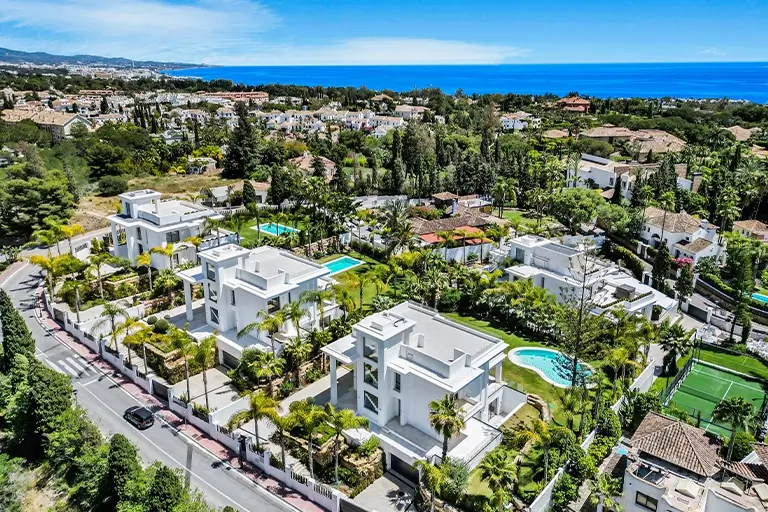
The photos show terraces overlooking the sea, well-tended gardens, swimming pools surrounded by greenery, and apartments where every detail comes together perfectly. The kitchen is bright, the living room seems more spacious than we imagined, and the bedroom offers a spectacular view of the sunset.
It's easy to fall in love with a project like this.
However, when we buy a property off-plan, we are not purchasing exactly what we see. We are buying the promise that the home will be built, completed, and delivered in accordance with specific conditions.
That's why, before paying the deposit for a new-construction home in Spain, it's worth looking beyond the renderings.
It's not about distrusting all developers or turning the buying process into a never-ending investigation. It's about knowing what we're buying, who is responsible for the project, and how our money will be protected during construction.
Buying off-plan means buying a property that is still under construction
A newly built home can be purchased at different times.
In some developments, construction is already well underway. In others, the building is just beginning to take shape. There are also projects that go on sale before the first stone has even been laid.
The sooner you buy, the greater your selection tends to be.
We can choose a specific floor plan, a better orientation, a larger terrace, or a unit located away from the pool and the busiest areas. In some cases, it’s also possible to customize materials, colors, or certain elements of the interior layout.
Buying early on may also offer a more attractive price than purchasing the same property once the development is complete.
In return, the buyer accepts a longer wait and greater uncertainty.
During that time, delays, technical modifications, or changes in the surroundings may occur. It is also possible that the view shown in an infographic may not be exactly the same as the one you ultimately see from the terrace.
That's why, when buying an off-plan home in Spain, it's not just about choosing an apartment. You have to understand the entire project.
The initial impulse usually arises before making a reservation
Many purchasing decisions start out in a similar way.
A buyer visits a new development, finds a home that fits their budget, and is told that only a few units are still available. The property has a good orientation, an attractive terrace, and someone else is probably also interested in it.
That's when the pressure sets in.
The deposit seems like a small amount compared to the total price. Paying it allows you to take the property off the market and buy time to prepare the rest of the transaction.
The problem arises when a reservation is made without fully understanding its terms and conditions.
Not all housing reservation contracts work the same way. In some cases, the money can be refunded if the legal review is not satisfactory. In others, the amount is nonrefundable if the buyer decides to withdraw.
There may also be significant differences in situations related to financing, building permits, or the deadlines for signing the private sales contract.
Before making a payment, you need to clearly understand which property you are reserving, how long it will remain off the market, and under what circumstances you might be able to get your money back.
A reservation should not be treated as a mere administrative formality. It is the first real commitment in the purchasing process.
Getting to know the developer is just as important as getting to know the property
Sales offices typically showcase a brand, a vision, and a lifestyle. However, behind every project lies a specific legal structure.
The company marketing the development is not always the same as the one listed as the landowner. Nor does it necessarily have to be the same as the company that signs the contract or receives the payments.
That's why, before buying a new-construction home in Spain, it's a good idea to find out who is actually behind the project.
The developer's track record can speak volumes. It's helpful to learn about other developments they've completed, visit some of their previous projects, and see how well they've held up over time.
A new home may look flawless at the time of delivery. Its true quality becomes apparent several years later, when we can assess the condition of the facades, terraces, common areas, and HVAC systems.
Not every development has to be owned by a large, internationally known company. Many local developers carry out excellent projects.
The important thing is that there be transparency regarding who is selling, who is building, and who will be held accountable if a problem arises.
A building permit is not just a minor administrative formality
One of the most important documents in any real estate development is the building permit.
This authorization confirms that the city council has approved the construction of the proposed project. While it does not in itself guarantee that everything will proceed without a hitch, it does mark a fundamental difference between an authorized development and a proposal that is still pending administrative decisions.
Some properties are put on the market before they receive their final permit.
This does not automatically mean that the project is unsafe. However, the buyer should be aware of this, and the contract must explain what will happen if the license is not granted or if the project ultimately changes.
This issue becomes particularly relevant when funds are requested before the project has received all the necessary approvals.
Therefore, before making any significant payments, an independent attorney should review the zoning status, the land title, and the permit corresponding to the specific phase of construction the home is in.
It's not enough to know that the promotion “will be licensed.” It's important to know whether it already is.
Where does the money you pay during construction go?
Buying a new home usually involves several payments before you receive the keys.
After the reservation is made, a private purchase agreement is typically signed. At that time, a percentage of the price may be paid. Additional payments may be due later as construction progresses, while the remaining balance is paid upon the execution of the deed.
This timeline can span months or even years.
During that period, the buyer should know how the down payments are protected.
When the applicable legal conditions are met, these payments must be backed by a bank guarantee or surety bond. The purpose is to ensure that the buyer can recover the money if the development is not built or if the home is not delivered as agreed.
There is an important difference between knowing that the development has financing and having an individual guarantee tied to the home and the buyer.
The document must specify the amounts covered, who issues the guarantee, and how it can be used in the event of a default.
It is also essential that payments be made only to the bank account specified in the documentation. A transfer made to a different account may complicate any subsequent claim.
A good location isn't always apparent from the showroom
When we look at a model or a digital image, all the homes seem to enjoy a prime location.
In reality, just a few meters can completely change the experience.
An apartment may be closer to the road than it seemed. The terrace may face another terrace. The playground may be located right below the bedroom. The entrance to the garage may run alongside the private garden.
Even within the same building, orientation and height can affect lighting, temperature, and views.
That's why it's worth studying not only the floor plan of the unit, but also the complete floor plan of the development.
You need to understand where the other buildings, swimming pools, entrances, elevators, gardens, and common areas will be located. It’s also a good idea to look at the nearby lots and see what might be built there in the future.
A view of the ocean can be spectacular and, at the same time, partial. It may depend on a specific angle or on whether the lot in front remains vacant.
Marketing images help you visualize the project, but they are no substitute for an analysis of the actual location.
Square meters can tell different stories
One of the aspects that causes the most confusion when comparing properties is the floor area.
Two apartments can be advertised as having a similar size yet offer completely different experiences.
The reason is that some properties include terraces, walls, or a proportional share of common areas. The usable interior space may be smaller than the buyer imagines when reading the listing.
Before signing the contract, it should be clear what area corresponds to the interior of the home, how large the terrace is, and what portion of the advertised size consists of common areas.
The layout is just as important as the total number of meters.
A slightly smaller apartment can be much more comfortable if it has a good living area, plenty of storage space, and a natural flow between the living room and the terrace.
On the other hand, a home with a large floor area may lose functionality due to long hallways, rooms that are difficult to furnish, or outdoor spaces that are hard to make good use of.
At Loriini, we don't just look at size. We also consider how each space will be used once the property is completed and furnished.
The building specifications should explain exactly what you will receive
The building specifications describe the finishes and materials planned for the development.
It may include information about the floors, windows, insulation, heating and cooling systems, kitchen, bathrooms, closets, and common areas.
However, not all memoirs provide the same level of detail.
Phrases like “top-quality materials” or “premium finishes” sound appealing, but they don’t really explain much. It’s better to find clear specifications about the products, systems, or features that will be used.
It is also important to review the clauses that allow the developer to substitute materials.
During a construction project, it may be necessary to replace a model that is no longer available. The problem arises when the contract allows for the replacement of any element without setting quality standards.
It is reasonable to expect that the alternative material have equivalent or superior characteristics and that it not reduce the functionality or value of the home.
The building specifications also help estimate the work that will be needed after receiving the keys.
A property may be delivered with a kitchen and appliances, but without decorative lighting, curtains, furniture, or outdoor furnishings. In other projects, even some elements that appear in the renderings are shown for illustrative purposes only.
Understanding what's included helps you avoid surprises when putting together your complete budget.
The price of the home is not the final budget
The advertised price is only part of the investment.
When buying a new-construction home in Spain, you need to consider taxes, legal fees, notary fees, registration fees, and—if you’re taking out a mortgage—the costs associated with it.
In addition to this, there may be furniture, lighting, curtains, patio furnishings, and any customizations made before or after delivery.
When purchasing a new home, the buyer typically pays VAT and stamp duty. The exact amount will depend on the type of property, the autonomous community, and the circumstances of the transaction.
It is also important to know the expected homeowners' association fees.
Modern developments may include swimming pools, gardens, a gym, security, a spa, or coworking spaces. All of these amenities enhance the project's appeal, but they also require maintenance.
A residential complex with extensive amenities can be an excellent choice, provided that the annual costs are in line with how the property will be used.
That's why, before making a reservation, we recommend working with an overall budget. This way, the buyer knows exactly how much they'll need to have a home that's fully ready to move into.
The due date should have a specific meaning
Construction projects don't always finish exactly on the originally scheduled date.
There may be delays due to supply issues, administrative changes, weather conditions, or technical difficulties. This is part of the risk of buying off-plan.
However, the contract should specify a sufficiently clear delivery period.
A date presented solely as an estimate—without specifying a deadline or explaining possible extensions—leaves the buyer in a state of uncertainty.
It's also a good idea to check what happens if delivery is delayed by several months.
The contract must explain when the buyer may grant an extension, when the buyer may request termination, and what happens to the amounts already paid.
The force majeure clause also deserves attention. It should not be used as a generic excuse for any delay.
Buying a home that will be delivered in the future requires a certain amount of flexibility, but it also requires setting limits.
Funding must be planned from the outset
Many people buy a newly built home with the intention of applying for a mortgage once construction is complete.
The problem is that a lot of time can pass between the reservation and delivery.
During that period, interest rates, bank criteria, the buyer’s employment status, or even the final appraisal value of the property may change.
An initial evaluation by the bank does not always mean final approval.
If the purchase depends on financing, this issue must be addressed before signing a contract that obligates you to complete the transaction.
It's also important to understand what will happen if the mortgage is ultimately not approved.
Without an appropriate contractual provision, the buyer may find themselves obligated to pay the remaining balance even if the bank has denied the loan.
Before receiving the keys, you should inspect the finished home
The moment of delivery is usually exciting.
After months of waiting, the house is finally a reality. We can walk into the rooms, open the windows, and take in the actual views from the terrace for the first time.
That is precisely why we should not rush the review.
Before finalizing the handover, it is advisable to conduct a technical inspection. This inspection checks the functionality of doors, windows, fixtures, the HVAC system, faucets, appliances, and drains.
We also inspect the floors, paint, finishes, the slopes of the terraces, and any possible leaks or defects.
Incidents must be documented in writing and with photographs.
Not all minor defects prevent someone from receiving housing, but there must be a clear procedure for correcting them.
In addition, before signing the deed, the buyer must confirm that the property has the necessary documentation to be legally occupied and that the registration status matches what was agreed upon.
Buying a home to live in is not the same as buying a home to rent out
A property may be excellent as a second home but not work as well as an investment.
If the goal is to enjoy the home for several months a year, factors such as peace and quiet, the terrace, the views, and proximity to everyday amenities may take priority.
If the plan is to rent it out, it will also be necessary to analyze demand, location, accessibility, parking, and maintenance costs.
In the case of vacation rentals, it is essential to check the current regulations and any restrictions imposed by the homeowners' association.
The fact that other homes in the area are rented to tourists does not automatically mean that a new property can be used in the same way.
The purpose of the purchase should be defined before choosing a development. Otherwise, it’s easy to fall in love with a home that doesn’t meet the actual objective of the investment.
The Role of an Independent Attorney
The lawyer representing the buyer is not there to hinder the transaction.
Its purpose is to verify that what is promised commercially matches the legal reality.
You can review the land title, encumbrances, permit, contract, warranties, and payment schedule. It also helps you understand the clauses governing delays, project modifications, and possible termination.
This is especially important when the buyer lives outside Spain, is unfamiliar with the local legal system, or signs documents in another language.
The sales office represents the developer. The agent facilitates the transaction. The notary verifies the legality of the deed.
The buyer also needs someone who will exclusively represent their interests.
How Loriini Supports the Purchase of a Newly Built Home
At Loriini, we start by understanding how you want to use the property.
We're not just looking for a specific number of bedrooms or a particular view. We're interested in knowing how much time you plan to spend in Spain, who will be living in the home, and how it should work in your day-to-day life.
From there, we select locations and promotions that meet those needs.
We also coordinate the process with independent attorneys, help compare properties, and analyze the spaces from the perspective of their future layout and furnishings.
Once the purchase is complete, we can handle the interior design, furniture, decor, patios, and the complete preparation of the home.
This way, the buyer doesn't have to coordinate separately with the agent, the designer, the suppliers, and the installation teams.
The goal is for the property to be more than just a good off-plan purchase. It should be a place that’s ready to be enjoyed from day one.
A good purchase starts before you sign the contract
Buying a new-construction home in Spain can offer many advantages.
It provides access to modern, efficient properties tailored to a contemporary lifestyle. It may also offer the option to choose a better location within the development and customize certain features.
However, the decision should not be based solely on an attractive image or the feeling that you have to act quickly.
Before paying for the reservation, it's a good idea to understand the project, review the documentation, and calculate the total cost of the investment.
The better you prepare for this first stage, the easier everything that comes after will be.
If you're thinking about buying a new-construction home in Spain, let us know what kind of property you're looking for. At Loriini, we'll help you compare locations, select the right development, and manage the entire process until the home is completely ready for you.
Frequently Asked Questions About Buying New Construction in Spain
Is it safe to buy a home off-plan in Spain?
This can be a safe transaction as long as you verify the developer’s background, the building permit, land ownership, the contract, and the protection of the funds you’ve paid. Hiring an independent attorney significantly reduces the risk.
Can the deposit for a new home be refunded?
It depends on the terms of the signed document. Before paying, you should make sure you understand under what circumstances the reservation is refundable and what happens if the legal review is not satisfactory.
What is a bank guarantee for new construction?
It is a guarantee that protects the amounts paid by the buyer during construction. It must be tied to the specific transaction and specify which amounts are covered.
How much tax do you pay on a new home in Spain?
The purchase of a new home is usually subject to VAT and stamp duty. The exact cost depends on the property, the autonomous community, and the circumstances of the purchase.
Can I buy a new-construction home from another country?
Yes. Much of the process can be handled through a lawyer and a power of attorney. Even so, it's a good idea to see the location in person and conduct an inspection before taking possession of the property.

Loriini Global
At Loriini, we believe in the art of living luxuriously. Founded with a passion for beauty and sophistication, we specialize in providing exceptional furniture, exquisite interior decor, and exclusive real estate that transform spaces into stunning sanctuaries.