


Real Estate in Spain for Foreigners – A Complete Guide for 2026
Buying property in Spain is one of the most appealing options for foreigners seeking sun, sea, quality of life, investment opportunities, or a second home in Europe. Spain offers a highly diverse real estate market, with properties for sale in major cities, coastal areas, rural regions, gated communities, and areas with high potential for living, renting, or investing.
The country attracts buyers from all over the world thanks to its climate, lifestyle, safety, cuisine, beaches, and excellent connections to other European countries. In addition, the Spanish real estate market offers properties to suit a range of budgets: from a compact apartment in a city to a villa with a pool, garden, garage, terrace, and ocean views.
In this comprehensive 2026 guide, you’ll find the essential information you need to understand how the process of buying property in Spain works for foreigners, the different types of housing available, which areas to consider, what expenses to expect, and how to choose a house, apartment, or property that meets your goals.
Can foreigners buy property in Spain?
Yes. Foreigners can buy property in Spain, whether they are residents or do not live in the country permanently. Buying a home is not restricted to Spanish citizens. People from other countries can purchase a house, apartment, villa, plot of land, or any other type of property, provided they follow the appropriate procedures.
To make a purchase, you usually need to obtain a NIE, which stands for Foreigner Identification Number. This document allows you to conduct business legally in Spain, pay taxes, sign documents before a notary, and register property.
It is also advisable to enlist the services of a professional to assist with legal verification, property analysis, contract review, coordination with the notary, and registration. For a foreign buyer, this support provides peace of mind and reduces the risk of errors.
Why Spain is attractive to foreign buyers
Spain offers a combination of factors that make it a highly attractive destination for homebuyers and investors. Its Mediterranean climate, proximity to the sea, wide range of properties, lifestyle, and quality of life are what lead many people to decide to buy a home in the country.
The Spanish real estate market has established itself as one of the top destinations for international buyers. Demand for housing has grown particularly in coastal areas, major cities, and vacation destinations. This demand is also driving sales of properties intended for rental, investment, and second homes.
Another important point is variety. In Spain, you can find modern new-construction properties, pre-owned homes, vacation rentals, luxury villas, traditional houses, city apartments, rural land, penthouses with terraces, beachfront bungalows, and homes in gated communities with swimming pools.
Types of Properties in Spain
The real estate market in Spain offers a wide variety of properties, from city apartments to coastal villas. This diversity allows every buyer to find a home that suits their budget, lifestyle, and purchasing goals.
Apartments
Apartments are residential units located in multi-story buildings. They are very common in cities such as Madrid, Barcelona, Málaga, Alicante, and Valencia. An apartment typically has several bedrooms, one or more bathrooms, a living room, a kitchen, a dining room, and, in many cases, a terrace, a storage room, or a garage.
An apartment is usually smaller than a flat and often has one or two bedrooms. It is a popular choice for foreigners looking for a home that is easy to maintain, located near the beach or in an area with good access to shops, supermarkets, restaurants, and public transportation.
There are also studios, which are open-concept units designed for one or two people. In a studio, the living room, kitchen, and bedroom are integrated into a single main room, creating a practical and functional space.
Houses, villas, and single-family homes
Single-family homes are detached or semi-detached houses that are very popular in suburbs, rural areas, and coastal regions. A single-family home may have multiple bedrooms, multiple bathrooms, a garden, a terrace, a garage, a storage room, a swimming pool, and more outdoor space.
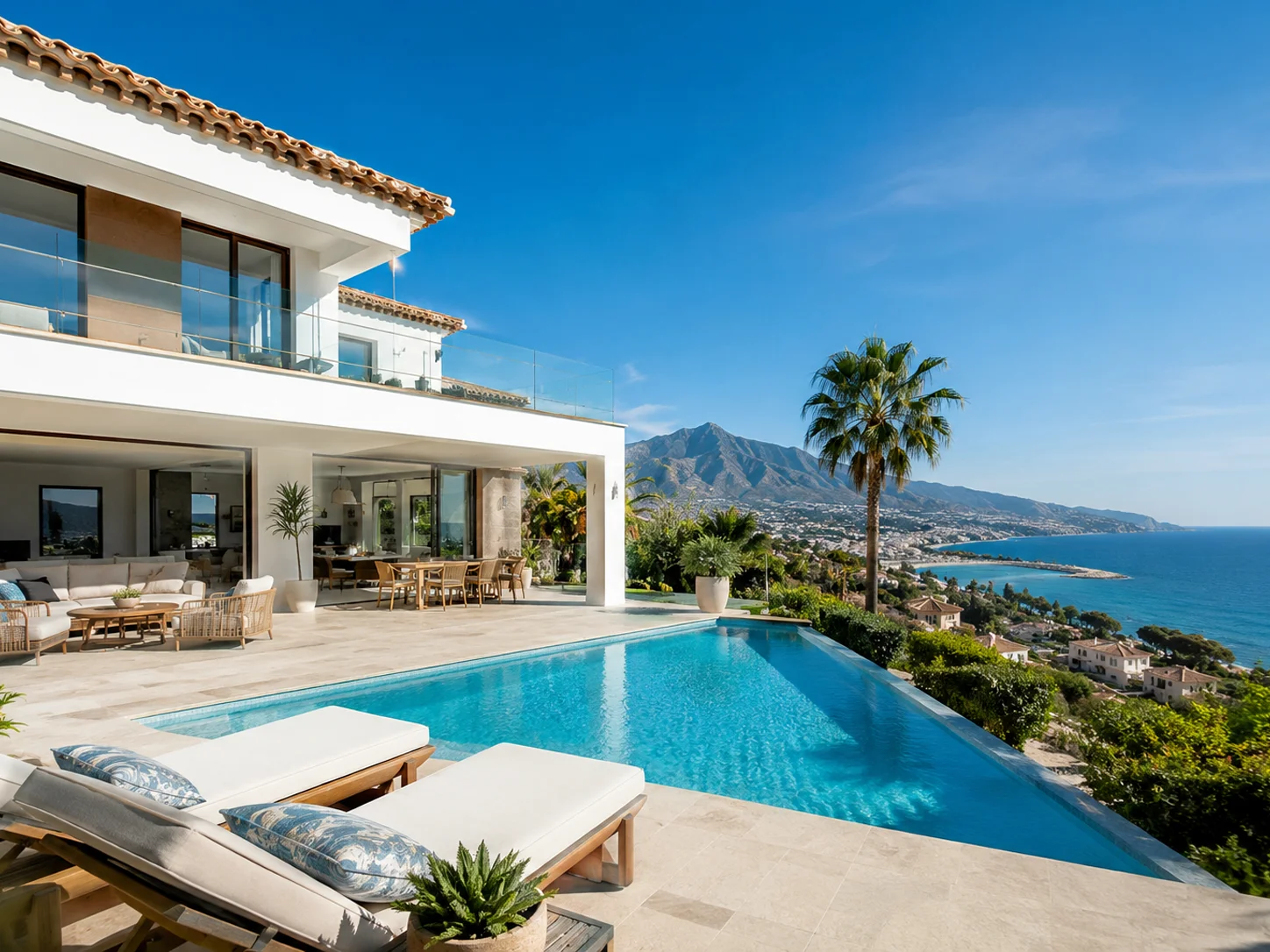
Villas are often associated with luxury properties, especially in areas such as the Costa del Sol, Marbella, the Costa Brava, and the Balearic Islands. A villa may feature ocean views, a private pool, a garden, a master suite, spacious bedrooms, air conditioning, heating, high-quality flooring, large windows, and a layout designed for comfort.
Townhouses and semi-detached homes are properties that share at least one wall with another home. They are common in housing developments and residential areas. They offer more space than an apartment, but are generally easier to maintain than a single-family home.
Penthouses, duplexes, and bungalows
Penthouses occupy the top floor of a building and are typically known for their private terraces, unobstructed views, natural light, and greater privacy. For many foreign buyers, a penthouse near the sea can be an excellent choice due to its combination of outdoor space, views, and comfort.
Duplexes are homes spread over two floors connected by an internal staircase. They can be found in both urban buildings and coastal developments.
Bungalows are single-story homes commonly found in coastal areas. They are typically practical, comfortable, and ideal for people who want to avoid stairs or are looking for a simple home near the sea.
Rural properties and land
Spain also offers traditional properties located on rural or agricultural land, such as cortijos, masías, and caseríos. These properties vary by region and can be of great historical, architectural, and scenic value.
Plots of land in rural areas are typically large and may appeal to buyers seeking peace and quiet, privacy, a spacious yard, or a building project. Before purchasing a plot of land, it is essential to review its zoning status, access, available utilities, and actual feasibility for construction.
Best Areas to Buy Property in Spain
Choosing the right area is one of the most important decisions you'll make. Properties in Spain are available in a wide range of locations, from major cities like Madrid and Barcelona to coastal areas such as the Costa del Sol and the Costa Brava.
Costa del Sol
The Costa del Sol is one of the most popular areas among foreign buyers. Málaga, Marbella, Estepona, Benahavís, Mijas, and Fuengirola offer a pleasant climate, beaches, the sea, golf, restaurants, amenities, international schools, and a wide range of properties for sale.
In this region, you can find apartments, flats, villas, townhouses, and luxury properties with swimming pools, terraces, garages, air conditioning, and ocean views.
Costa Brava
The Costa Brava is a region highly prized for its scenery, its coves, its Mediterranean charm, and its proximity to Barcelona. Some of the most expensive properties in Spain are located in Barcelona and on the Costa Brava, especially when they combine a prime location, ocean views, beach access, and high-quality finishes.
For foreigners looking for a charming home in a beautiful natural setting close to a major city, the Costa Brava may be an attractive option.
Community of Madrid
The Community of Madrid attracts buyers looking for a home in an urban area with access to businesses, cultural attractions, schools, hospitals, shops, and international connections. The market here is dominated by flats, apartments, penthouses, homes in gated communities, and family homes featuring multiple bedrooms, bathrooms, a garage, and a storage room.
Madrid may not have a coastline, but it does offer a robust market, high demand, good liquidity, and opportunities for investment or long-term rentals.
Barcelona and other major cities
Barcelona combines city life, the sea, culture, and an international real estate market. Property prices can be high, especially in central areas or those near the sea. Buyers can find everything from a classic apartment with balconies to a modern apartment with air conditioning, a terrace, and views.
Other cities such as Valencia, Málaga, Alicante, and Seville also offer opportunities for those looking for a home in Spain with good infrastructure and an urban lifestyle.
The Costa Blanca and more affordable areas
The Costa Blanca is known for offering a great balance of price, climate, and proximity to the sea. Alicante, Torrevieja, Orihuela Costa, and Benidorm all have a wide range of apartments, houses, villas, and properties tailored to foreign buyers.
In many areas of the Costa Blanca, it is possible to find more affordable properties than in Marbella, Barcelona, or the Costa Brava.
What to Check Before Buying a Home in Spain
Before buying a home, it’s important to look beyond the photos in the listing. Listings may show a terrace, pool, living room, kitchen, bedroom, bathrooms, or views, but they don’t always explain the legal status, expenses, orientation, distance to the beach, or actual maintenance costs.
Location and distance
The distance to the beach, the airport, the supermarket, shops, the school, the hospital, or downtown can significantly affect a property’s value. A home located a short distance from the ocean may be more attractive to renters, but it may also command a higher price.
Property Status
You should inspect the overall condition of the home: windows, floors, utilities, air conditioning, heating, bathrooms, kitchen, walls, moisture, layout, storage, storage room, garage, and common areas.
An older home can have a lot of charm, but it may also require some renovation work. A new apartment can offer comfort, but it may come with a higher price tag.
Bedrooms, bathrooms, and floor plan
The number of bedrooms and bathrooms directly affects the property’s usability and future resale value. A two-bedroom, two-bathroom home is generally more versatile than a one-bedroom apartment. A three- or four-bedroom house may appeal to families, while a studio apartment may be suitable for a single person or a couple.
Layout matters too. An open floor plan connecting the living room, kitchen, and dining room can enhance the feeling of spaciousness. A master suite, a spacious terrace, or large windows with views can increase the property’s appeal.
Air conditioning, heating, and comfort
In many regions of Spain, air conditioning is essential, especially in coastal areas and cities with hot summers. It’s also a good idea to check the heating system, energy efficiency, windows, and the building’s orientation.
Comfort isn't just about size. A well-oriented home with good ventilation, efficient air conditioning, a functional terrace, and convenient access can be much more pleasant than a larger property with a poor layout.
Purchase and maintenance costs
When purchasing property in Spain, buyers should expect additional expenses on top of the purchase price. These may include taxes, notary fees, land registry fees, administrative agency fees, legal fees, translation costs, financing costs, and other administrative expenses.
After the purchase, there may also be expenses related to homeowners' association fees, property taxes, insurance, utilities, and maintenance of the pool, garden, garage, storage unit, or common areas.
Properties for sale: how to search effectively
Many buyers start by looking at listings on real estate platforms. It’s a good way to get a sense of the market, compare prices, neighborhoods, the number of bedrooms and bathrooms, distance to the beach, and property types.
However, not all listings provide complete or up-to-date information. Some properties for sale may be reserved, have incomplete details, or fail to reflect all associated costs. That is why it is advisable to verify the information through a local service or a real estate agent.
It’s also important not to limit yourself to a single search term. A property may be listed as a flat, apartment, house, villa, townhouse, or duplex, and each platform may use different criteria.
Buying, Investing, and Renting
Buying real estate in Spain can be an attractive investment, especially in areas with high demand from tourists or residents. Investors typically look for properties with potential for rental, resale, or mixed-use.
Short-term rentals can generate income during the tourist season, while long-term rentals can offer greater stability. Before buying a property with the intention of renting it out, you should review local regulations, homeowners’ association rules, licensing requirements, actual demand, and management fees.
A home near the beach, with a terrace, air conditioning, a pool, several bedrooms, comfortable bathrooms, and good access is usually more appealing for vacation rentals. On the other hand, a well-located city apartment may be better suited for long-term rentals.
How much does a typical house cost in Spain?
The price depends largely on the area, the type of property, its condition, its distance from the beach, the number of bedrooms, the bathrooms, the terrace, the garage, the pool, and the quality of construction.
As a general guide, a one-bedroom apartment on the resale market can be found starting at around 45,000 or 50,000 euros in more affordable areas. A simple single-family home can start at around 120,000 to 150,000 euros, although in premium regions such as Barcelona, the Costa Brava, Marbella, or certain areas of the Costa del Sol, prices can be much higher.
How many properties are there in Spain?
There is no single figure that accurately reflects the total number of properties in Spain, because it depends on whether we are talking about homes, real estate, residential properties, commercial properties, land, or properties for sale at a given time.
The key point for foreign buyers is that the Spanish market is vast and diverse. Properties are available in cities, towns, rural areas, coastal regions, mountain areas, residential developments, tourist regions, and major metropolitan areas.
How long do I have to live in a property before it becomes mine?
Buying a home in Spain means that the property becomes yours once the purchase is finalized, the deed is signed, and it is properly registered. You do not have to live there for a certain number of years for the property to become yours.
Acquisitive prescription is a different matter altogether; it is a very specific and complex legal procedure. For a standard purchase, security comes from conducting the transaction properly, signing the documents before a notary, and completing the property registration.
What is the most affordable town to live in Spain?
The most affordable town can vary depending on the region, the market, and the time of year. In general, inland towns tend to be cheaper than coastal areas, large cities, or tourist destinations. Distance from the sea, access to services, the condition of the housing, and local demand all have a significant impact on prices.
For a foreigner, it is best not to choose based solely on price, but to consider safety, connectivity, amenities, shops, supermarkets, access to medical care, transportation, the local community, and quality of life.
Conclusion
Buying property in Spain as a foreigner can be an excellent decision if you carefully analyze the market, the area, the type of property, the costs, the condition of the property, and your reason for buying.
Spain offers city apartments, beachfront apartments, family homes, luxury villas, rural land, penthouses with terraces, bungalows, and properties with swimming pools, garages, storage units, air conditioning, and views. The key is to choose a property that fits your lifestyle, your budget, and your future plans.
At Loriini, we help international buyers find properties in Spain and transform them into spaces ready to live in, enjoy, or invest in. Our service combines property search, purchase, interior design, furnishing, management, and local support to ensure the process is clear, secure, and hassle-free from the very first contact.

Loriini Global
At Loriini, we believe in the art of living luxuriously. Founded with a passion for beauty and sophistication, we specialize in providing exceptional furniture, exquisite interior decor, and exclusive real estate that transform spaces into stunning sanctuaries.